MY WEEKLY BLOG

.png)
MY FIRST WEEK

I attended the Onboard Briefing via Google Meet at 8:00 a.m., where I met the members of the organization and gained insights into their individual work . The meeting provided us with an introduction to DICT according to the Law RA 10844, highlighted DICT’s flagship initiatives, discussed DICT’s goals within the community, and .covered the tools we’ll need for our work, as well as the expected final output for our Internship Program.
Day 1
DICT REGION V - SORSOGON
At 1:00 pm, the other interns and I joined a Google meeting with Sir Gerald, who is in charge of the BPLS project, a cloud-based platform developed by DICT for LGUs to streamline and automate the processing of Business Permits, Barangay clearances, Building Permits, and Occupancy Permits. During the meeting, he taught us about the purpose of Joint Memorandum Circular series of 2016, which contains revised standards for processing business permits and licenses in all cities and municipalities. He also covered guidelines for processing business permits, related clearances, and licenses in the new normal in all cities and municipalities. Furthermore, Sir Gerald explained Republic Act 11032, which aims to reduce red tape and processing time. As part of this, they set up service standards through billboards, websites, and published materials for businesses to assist clients and implement a zero-contact policy. He also shared the challenges of obtaining business permits in the past when people had to fill out numerous paper applications and the improvements made through their systems to simplify transactions and create a unified application form for faster online permit processing. Sir Gerald also discussed the penalties under Republic Act 11032 for violations. Moreover, he shared insights about his work and how we will obtain these permits, as well as the potential impact of this new system on LGUs


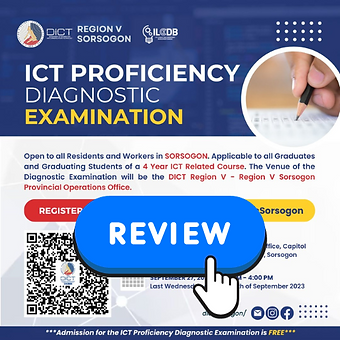
Yesterday, Ms. Lydeline asked us if we wanted to join the ICT Proficiency Examination scheduled for September 27, 2023. The exam consists of two levels: Level 1, which is a pen and paper test, and Level 2, which will involve hands-on programming. We all agreed to take the exam. Today, on September 19, at 8:00 AM to 12:00 AM, Mam Lydeline sent us the reviewer. Our task for the morning was to review for the ICT Proficiency Diagnostic Examination and watch the video she sent to us.
Day 2
From 1:30 PM to 3:30 PM, Mr. Gerald continued the discussion about the IBPLS project. He showed us a short video explaining the process of IBPLS for Business Permits and Barangay Clearance automation. Additionally, he shared information about the Philippines’ ranking in the World Bank since 2016, which led to the revision of JMC standards. Mr. Gerald also explained the objectives of the IBPLS project, which aims to establish a web-based business permits and licensing system. This system not only aims to enhance the LGU’s business tax collection performance but also to provide vital information for monitoring delinquent and inactive businesses and, most importantly, to improve the quality of service to the public. During his presentation, Mr. Gerald also touched upon the responsibilities of DICT and the LGU, emphasizing the need for collaboration and support. He provided insights into the requirements DICT needs from LGUs to ensure they are ready to use the system, including staff readiness and facility maintenance. Mr. Gerald explained the process of obtaining business permits, both online and onsite. Before concluding the meeting for the day, Sir Gerald provided an overview of the system’s modules and a brief description, which will be continued tomorrow.
.jpg)
Day 3
Our work plan for today was to review for the DICT proficiency test, but this morning, from 8:00 AM to 12:00 PM, we approached Mam Lydeline with a request. We needed to go to school to pick up our OJT uniforms, which are required attire during our internship. Our school’s OJT coordinator asked us to take pictures wearing the OJT uniform, and we also needed to visit the DICT office for these photos

In the afternoon, Mr. Gerald continued the discussion about the IBPLS project. He introduced us to the main system module, which is broken down into six parts. First, there’s the Application section, where clients fill out their business information. Next is the Verification stage, where BPLO officers inspect the client’s business, including gross sales and type, to verify the information. Once verified, it goes to Endorsement, where officials check if everything meets the requirements, including declared fees. Then it moves to Assessment, where all charges are computed, including default charges. Clients can choose to pay either online or onsite, depending on the LGUs. After payment, the system generates tax documents, Mayors Permits, and Barangay Clearances with seals. Mr. Gerald also introduced us to the system users and their roles. He focused on the System Administrator, explaining how they set up LGU profiles, manage data, handle user management, and auditing. We saw the real system in action, learned about user registration, and discussed system security. He even showed us how to create an email account and provided some Gmail tips. When it came to technology used on their website, he shared insights into the system’s development and features. He demonstrated the link to each page, emphasizing the administrator’s role and system functionality, particularly in terms of security. His discussion about the System Administrator took an hour, and tomorrow he will discuss the next user of the system, the IBPLO.

Day 4
Our work plan for today was to review again for the DICT Proficiency test. We filled out the application form for the examination and submitted it via Google Forms. After submission, we reviewed another video about the exam on YouTube, which was available on the DICT official YouTube channel.

In the afternoon, at 1:30 pm, we attended Mr. Gerald’s Google meeting, where he continued his discussion from yesterday. This time, the focus was on the IBPLS process flow. He didn’t cover the System Administrator today since we already discussed that yesterday. Instead, he moved on to discuss other users who weren’t covered yesterday. He started with the Endorsing Offices. Mr. Gerald opened an account in the system and showed us what they do in this part, which involves checking business violations, compliance with requirements, and reasons for application reassessment or decline. He also explained the fees associated with violations, renewals, or lack of FCIS or Sanitary Inspection. As Mr. Gerald navigated the system, it became apparent how extensive it is. The BPLO user part, primarily focused on reviewing documents and verifying applicant details and submitted requirements, appeared to be the most substantial module in the system. It covers the entire business permit process, including the applicant’s information, verification, assessment, endorsement, records, application status, application type, and business type. Lastly, Mr. Gerald discussed the Treasury user, showing us how the treasury computes revenue codes for LGUs. He explained the various charges for different business services, renewal, or retirement, depending on the client’s needs. It involves a lot of calculations and specific formulas that the treasurer relies on. I was impressed by the size of the system and found some features that I want to incorporate into my capstone thesis.
Day 5
This marks the end of my first week at DICT. In the morning, from 8:00 AM to 12:00 PM, the work plan was to review again for the DICT Proficiency test. I focused on reviewing my notes from my first year and revisiting the syntax of C++.

In the afternoon, the other interns and I joined Mr. Gerald in a Google meeting. He continued his lesson about system users, with a deep focus on the main module. He began by delving into the treasury aspect, which involves complex computations. He explained how the treasury adds taxes and fees to businesses based on revenue codes. The computation method varies depending on the LGU’s approach. Mr. Gerald also clarified which businesses have common fees, iterated fees, or divided fees based on the type of application. Next, he discussed the BPLO part, providing insights into various processes and displaying a table with all client transactions, application statuses, and the next steps to be taken. I asked him about the entire process after the treasury, endorsing offices, and BPLO have completed the necessary parameters for the transaction. He skipped the application part and proceeded to BPLO, where he filled out information based on whether the client’s transaction was walk-in or online. Details took effect in the system for online transactions, while walk-in clients had their documents scanned and uploaded to the system. The next step involved the unified form application going to the BFP for FSIC, where they checked requirements and fees.
Then it returned to BPLO and underwent MEO checking of documents for approval before heading back to BPLO for verification. Once verified, it proceeded to the treasury for charges, taxes, or fees. The treasury inputted these based on LGU charges or taxes as per the revenue code. The client paid, and the system processed the issuance of licenses. Moreover, he showed us the complete process within the system, going beyond explaining the process flow found on banners or their website. It provided an in-depth look at the entire iBPLS process, which left me feeling overwhelmed by the system’s complexity compared to what we’re working on in our capstone
